




Home | Admission Blogs | Science |
While many associate science with silent labs and solitary study, the true spirit of inquiry is found in the moment a student steps forward to share a discovery with the world. This January, Flint Hill moved beyond the traditional classroom setting to host its inaugural Science Exhibition, an event that transformed the campus into a vibrant center of intellectual exchange. Far from a standard school fair, this showcase signaled a bold new era for our program, highlighting the transition our students make from curious observers to high-level researchers.
The timing for such an event was perfect, as the Science Department’s goals for our students were met by a new level of support from two deeply aligned sources. The newly established Shenai-Mundkur Family Endowed Fund for Science Research provided the long-term foundation to elevate that vision into reality, while a special gift from an Upper School multi-generational family with a deep commitment to education and science offered immediate momentum. Together, these investments met our educators’ aspirations at a pivotal crossroads, transforming the campus into a vibrant center of intellectual exchange and ensuring students move from consuming knowledge to actively creating it.
By providing essential resources for ambitious research and travel to conferences, the endowed fund, complemented by this additional family support, helps young scientists bridge the gap between an initial spark in the lab and the professional stage. These gifts have turned a shared vision into a lasting pillar of the Flint Hill experience, underscoring the transition our students make from curious observers to confident, professional-level researchers
For Flint Hill Science Department Chair Zack Krug and the rest of the faculty, the motivation was simple: they wanted to give students a platform that matched the rigor of their work. “We ask the students to do a lot of independent thinking, argumentation, and scientific research in our classes,” Dr. Krug says, “and we wanted to give them the opportunity to share those results with their peers, families, teachers, and the general public.”
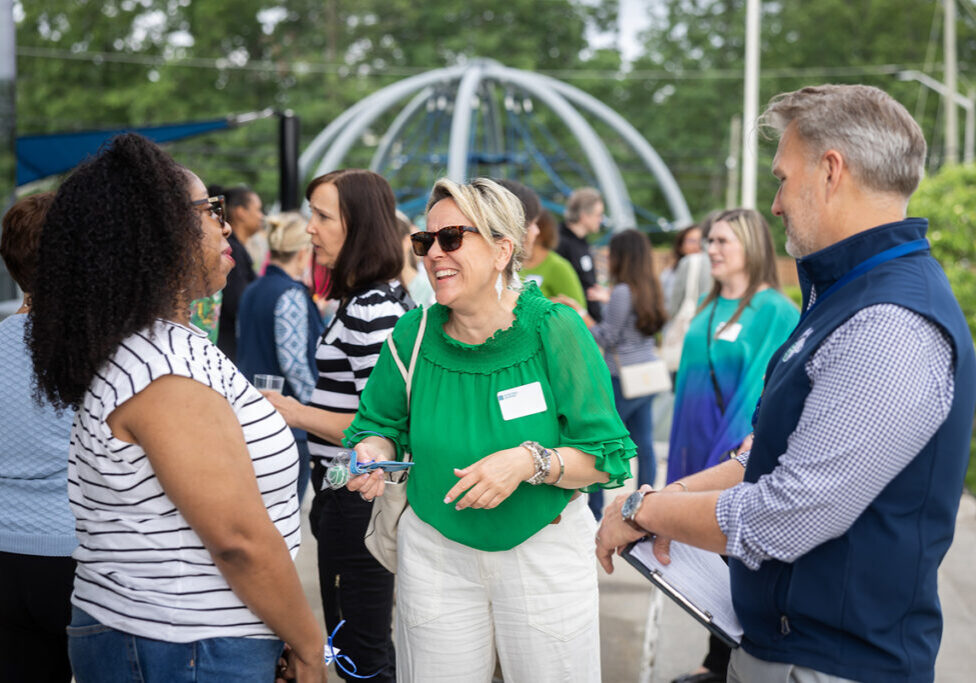
On the afternoon of January 30, visitors stepped into a "Celebration of Learning" that showcased the full spectrum of the program. The halls buzzed with the technical precision of the Science Olympiad teams, who tackled engineering challenges in a high-stakes showcase. Nearby, classroom activities were brought into the common areas, while the Research Scholars Gallery served as the heart of the event.
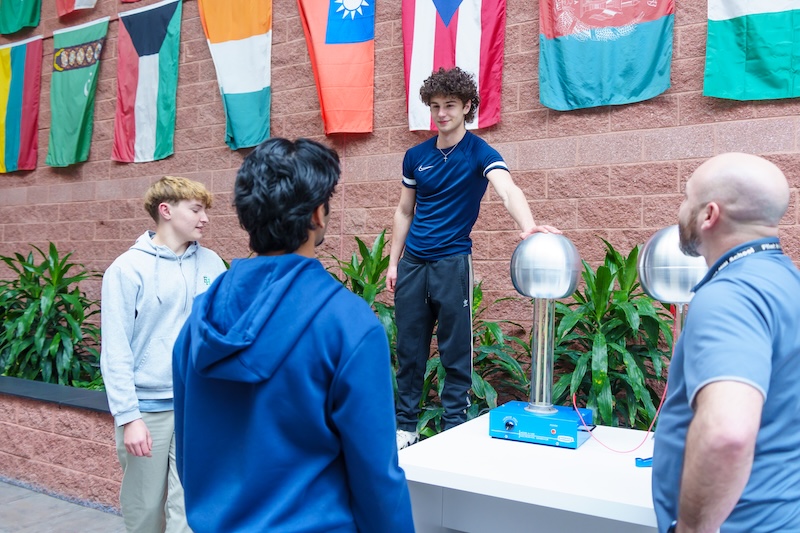
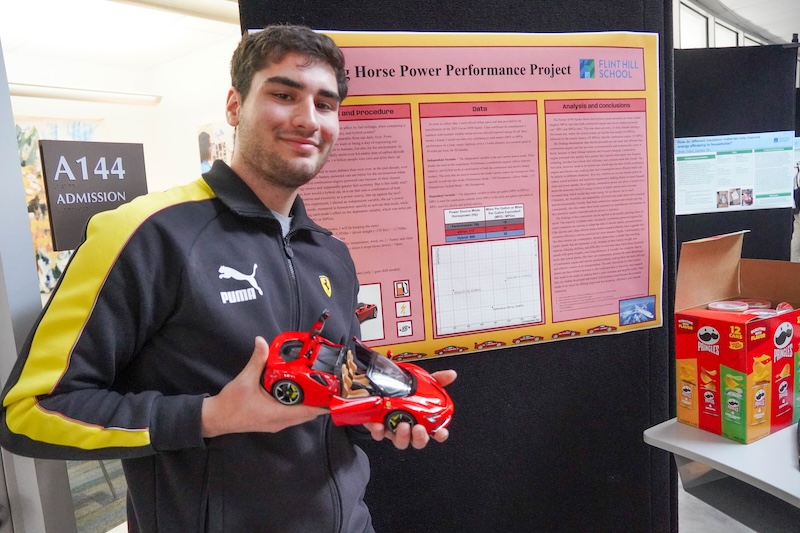
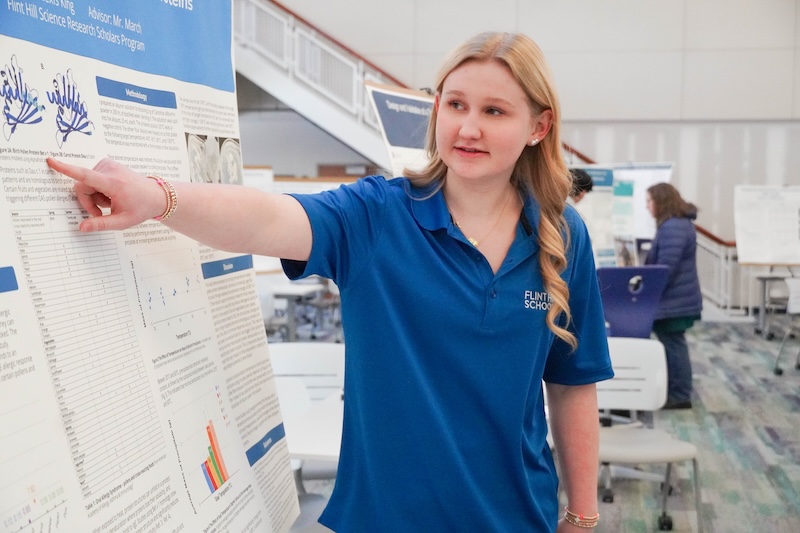
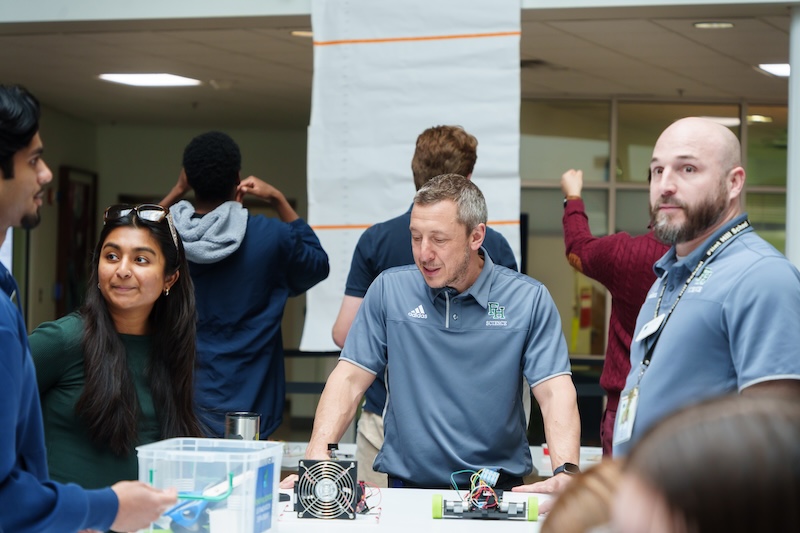
The caliber of the work reflected a voluntary dedication that went far beyond the classroom. As Krug observed, none of this extra work was required; students chose to return to projects from previous years, revising visuals and refining their data to ensure they were putting their best foot forward. "They did it because they wanted to," Dr. Krug notes, describing how students frequented office hours to build their posters from scratch and polish their findings to a higher standard.
Walking through the Commons and the Learning Commons, the sheer variety of research was as striking as its complexity. In one corner, you could find students presenting about the future of our planet, moving past surface-level talk to investigate real-world solutions. One participant broke down the science of mycoremediation (the clever use of fungi to clean up pollutants) while others brought the focus closer to home with a meticulous audit of Flint Hill’s own carbon footprint.
In one particularly relatable exchange, one of our Research Scholars explained the science behind "oral allergy syndrome" — how temperature fluctuations can physically alter the structure of allergenic proteins, rendering them unrecognizable to our immune systems, and the reason a person might react to a raw carrots but find them perfectly safe to eat once cooked.
Technical displays pushed into the realm of high-level physics, featuring everything from the design of a thrust-vector-controlled model rocket to the study of chaos in multi-nonlinear inverter systems. Whether the subject was the impact of music on the teenage brain or the potential for genetically modifying coral to survive warming oceans, the underlying message was clear: progress requires the courage to ask "what if" and the technical discipline to find the answer.
This visibility is a vital step in a student’s development. As Dr. Krug explains, "Scientific research must be shared. Our students have done some amazing things, and the next step is to have the experience of sharing and discussing their results. This is what would happen in the professional world."
Director of Academics Aaron Proctor agreed, noting, “Every outside guest I spoke with was thoroughly impressed with the high level of scientific thinking being demonstrated by our students.” While the afternoon marked a successful debut, it was clear that for these rising scientific talents, the real work of innovation is just beginning.
Posted in: